Once a major storm has made landfall, we start our proven emergency response plan to get life back to normal safely and as quickly as possible.
Gulf Power concentrates restoration efforts in the areas and on the power lines that restore electricity to the greatest number of people in the shortest time. Emphasis is placed on vital community services such as hospitals, emergency services and public safety and water and sewage stations.
Because we cannot predict when your service will be restored, we suggest that you make arrangements for persons with serious medical problems or other disabilities to be moved to another location where service is available, until power is restored.
We do not make restoration priorities based on where your home is located, your credit history with us or how often you call us to report the outage.
How the restoration process works
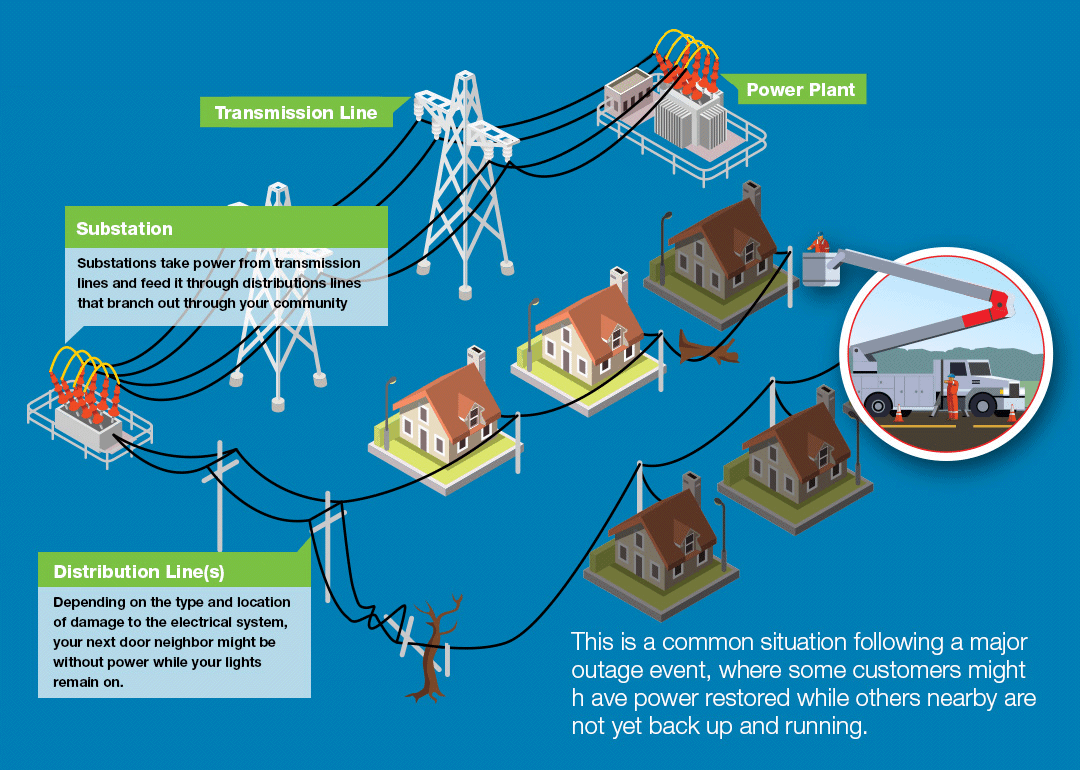
We start at our power plants and work first on the large lines going out to the communities from the plant. While working on these main transmission lines, focus goes to the next largest lines – the main feeders or distribution lines in a community, along with restoring power to essential services such as hospitals, water and sewer plants and fire and police stations. Next we repair damage that will return power to the greatest number of customers in least amount of time.
After these are repaired, smaller lines are repaired until the crews get down to the individual lines in neighborhoods.
Post-storm frequently asked questions
Is there priority given to certain facilities or locations during a widescale restoration?
- After facilities to make and move power are repaired – power plants, transmission lines and substations – the focus shifts to emergency responders such as facilities critical to public health and safety like hospitals, police and fire stations, water reclamation sites and communications systems. Following emergency service restoration is the large service areas which, when restored, will energize large amounts of customers efficiently.
What do you mean by “those able to accept power?”
- Some homes and businesses are so damaged that crews are unable to connect power. Please call Gulf Power at 1-800-487-6937 and a representative can help you determine if your home or business can receive power.
- View infographic on steps to restore power if your home’s service connection is damaged.
Everyone on my street has power but me. Why?
- Most likely, either your service line from the pole is disconnected or your home has damage to your weather head mast or meter box. That equipment is your responsibility to repair. Please call Gulf Power at 1-800-487-6937 to report your outage.
Why did my power come back on and then go off later?
- There are several reasons why your power can go off temporarily after restoration. Power to your area may have been shut off in order to safely restore service to other areas or there may have been residual damage that occurred such as a tree limb falling on a power line.
Sometimes I see crews parked. Why?
- Some of the reasons why there may be a crew parked are that they may have finished their prior assignment and are reviewing their next assignment, they may be requesting additional equipment and materials, or they may need to wait for electrical switching to occur to make the line safe for them to work.
Why are crews leaving my neighborhood when power is still out?
- The crews may need to pick up more supplies to continue restoration, conditions have become unsafe or repairs are still underway to other portions of the system, such as transmission lines or substations.
There is a lot of damage in the area, including downed lines in my neighborhood. Am I able to move these or do I need to wait for trained personnel to assist?
- Stay clear of areas where there is a lot of debris or downed trees because it could conceal an energized power line. Also stay clear of chain link fences which may be energized if touching a downed line.
- Treat any downed wire as if it is energized because you can’t tell by looking if a downed wire is live or not. Telephone or cable television wires that are touching a power line could become energized and should also be avoided. Call 911 to report the location of any downed lines.
- Standing water (puddles from flooding) may be energized from a downed line. Be careful not to touch or step in water near where a downed power line is located. If a downed line is near water — even a small puddle — keep well away.
Don’t attempt to repair the electrical system or pull tree limbs off lines. Let our trained work crews perform this potentially dangerous work.
What you can do after a storm
While we're working around the clock to restore power, here’s what you can do to stay safe and protect your electrical equipment:
- Make the safety of your family and home your top priority. Stay far away from downed power lines and flooded and debris-laden areas that may be hiding downed lines. Get more storm safety tips. Report downed power lines or unsafe equipment by calling 911 or Gulf Power at 1-800-487-6937.
- Should your power go out, turn off and disconnect electronic equipment such as computers, TVs, streaming devices, game consoles, microwave, etc. to prevent possible damage. Leave a single lamp or radio turned on to alert you that power has been restored.
- Visit GulfPower.com/storm from your computer or smart phone to report and check the status of an outage. You can also stay tuned to local radio, TV and newspapers for the latest information and estimated restoration times. Stay connected with us at: Outage Map, Facebook, Twitter & Instagram
- If you use a generator, use it safely. Read our generator safety tips.
- Continue to conserve refrigeration. Keep the refrigerator and freezer doors closed to help food keep longer. Once power is restored, check food for spoilage; if in doubt, throw it out!
- Remove debris away from utility poles and from under power lines to help clear the way for us to restore power – as long as it is safe to do so. See how to safely remove debris.
- Photograph or videotape your home – inside and outside; take inventory to determine and record losses.
- If your neighborhood gets its power restored, but you’re still without power:
- Check all circuit breakers and fuses to help determine if they are the issue.
- Visually inspect the area near the meter - if the meter or any of the piping or wires on the wall of the building are gone or look damaged, call an electrician. Check out this guide if your home’s service connection is damaged.
- If no problems are apparent, report your outage online or call us at 1-800-487-6937.
Emergency assistance information from local and national resources to help you.
Use our online power outage map to track outages and restoration.
Get the latest outage information with our mobile app.